Exports
One session leaves the tool in every format your stack reads — and each export covers the target’s complete namespace, so nothing falls back to an off-brand default.
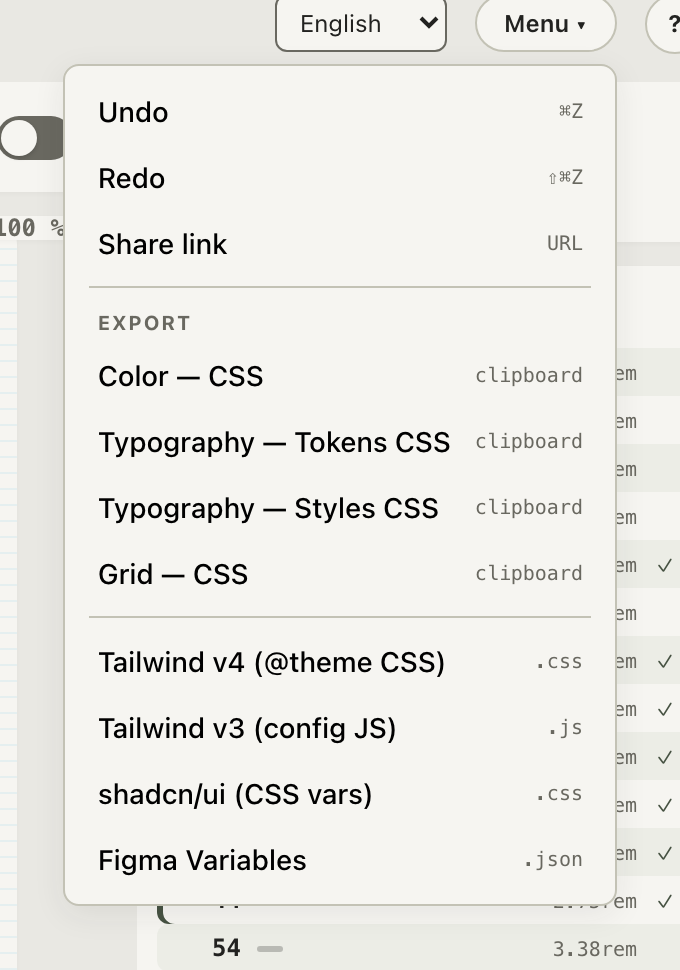
Quick exports (clipboard)
Per-view CSS, one click, straight to the clipboard:
- Color — CSS — primitives (
--color-brand-500…) and the derived semantic roles (--background,--foreground,--primary,--ring, surface and status tokens), with a usage guide in the file header: which tokens cover 90 % of cases, and the rules for surfaces vs status. - Typography — Tokens CSS — the scale as custom properties, with
line heights on the baseline grid; fluid mode exports
clamp()expressions. - Typography — Styles CSS — ready element styles (headings, body, lead, lists) built from the tokens.
- Grid — CSS — container and column variables per breakpoint, as media queries.
System files (download)
- Tailwind v4 — an
@themeblock: colors, font sizes, spacing, radii, shadows, easing — the full namespaces, including overriding the stockease-in/out/in-outwith your motion profile’s curves. - Tailwind v3 —
theme.extendas a config file: nested color primitives with literal semantic tokens, border widths, and aDEFAULTmerge where an intent name collides with a palette name. - shadcn/ui — the complete contract in the current dialect
(
:root+.dark+@theme inline): brand-tinted--accent, secondary-palette--secondary,chart-1..5drawn from your palettes’ most saturated steps, and the sidebar family. The legacy HSL format ships as a commented alternative. - Figma Variables — collections for color (light/dark modes), typography, and layout with one mode per breakpoint; effect values as float variables plus shadow effect styles.
Every file opens with a generated header naming the tool, the scale parameters, and any deliberately excluded subsets — an export you can audit, not just paste.
The completeness principle
An export that covers half a namespace is a trap: the utilities you forgot inherit framework defaults, and the design drifts exactly where nobody is looking. Scale Composer’s rule is to cover the target’s entire namespace — every radius name Tailwind knows, every shadow size, every easing keyword — or to declare the exclusion in the file header. What your system does not define, it should still decide.
The design tokens guides cover naming, layering, and how tokens travel between tools.