Design Tokens Are the Interface Between Design and AI
Design tokens work as the interface between design and AI because they
store design decisions as data: each token pairs a name — accent,
space-4 — with one exact value, in a file both sides can read. The AI
becomes one more consumer of the same source that already feeds CSS, Figma
and native code; instead of guessing what your design intends, it reads
it.
That sentence carries three claims — tokens are a contract, AI is a consumer, and referencing is what makes AI output steerable — and this article, the conceptual piece of our guide to AI and design systems, takes them one at a time.
What makes a token file a contract?
A contract, in the software sense of the word: an agreement about names
that lets two sides change independently. The names are stable; the values
behind them may change. The design side is free to change what accent
stores — a rebrand, a seasonal theme, a dark variant — and every consumer
that referenced the name updates without being touched. The consumer side
is free to use accent in a thousand places without owning, or even
knowing, the value behind it.
This only works because tokens are decisions stored as data — our introduction to design tokens builds that idea up from scratch. A PDF style guide states the same decisions for a human reader; a token file states them in a form that a build step, a design tool, or a language model can act on. The moment a decision has a machine-readable name, anything that reads files can honor it.
Why is AI just another consumer?
Because the consumer list was always open-ended. A token source has never been consumed directly: stylesheets consume a generated set of custom properties, Figma consumes generated Variables, native platforms consume generated resources. Each consumer gets a rendering of the same decisions in the format it reads best. An AI coding tool slots into that list without ceremony — it reads whichever rendering lives in the repository, usually the CSS custom properties or a Tailwind theme; the setup itself is covered in how to give an AI coding tool your design system.
Nothing AI-specific had to be invented for this: no new format, no plugin, no protocol. The same file that follows the DTCG format specification for interchange between design tools is also, from the model’s point of view, plain readable context. The discipline the industry adopted to keep design files and shipped code in agreement extends unchanged to the newest participant.
What does “reference, not value” make possible?
Steerability. When a model writes a raw value into a component, that value is a snapshot of a guess — plausible at generation time, disconnected from everything afterward. When it writes a reference, the output stays bound to the source. Two consequences follow, one for each direction of time:
- Backward: past output stays correct. Code the AI generated in March
still says
--color-accent; change what the token stores in September and that code renders the new decision without being revisited. - Forward: generation becomes bounded. Asked to pick a color, a model chooses from an effectively unbounded space of plausible values. Asked to pick a role from a file in its context, it chooses from a dozen visible names. Reviewing every value a generator invents does not scale; requiring it to invent none does.
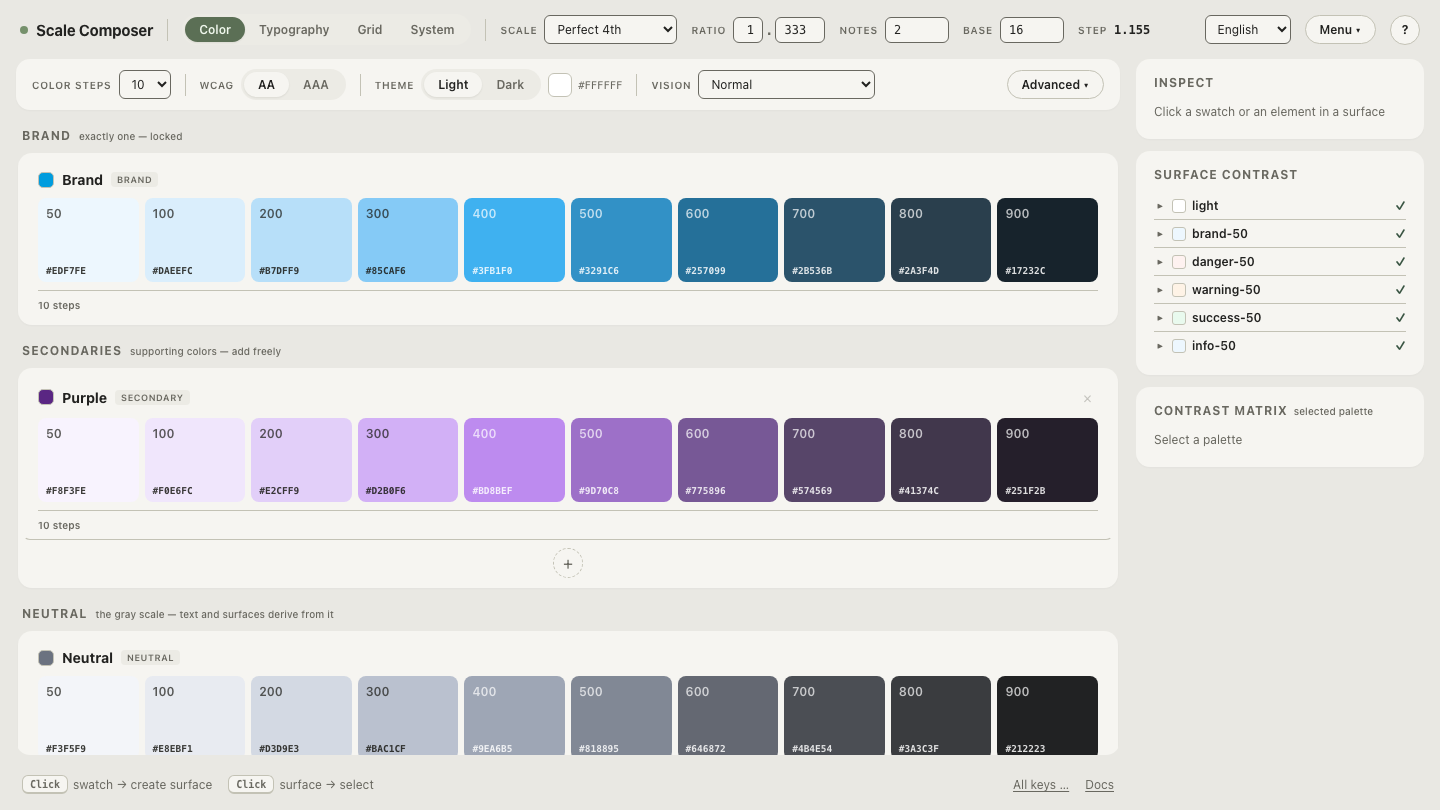
Open the DTCG file Scale Composer generates to see the
contract in its raw form — primitive tokens holding exact OKLCH values,
and semantic roles like background, text and accent that reference
them rather than repeat them. The reference syntax is the whole idea in
one line of JSON.
What happens when one decision changes?
It propagates — that is the payoff of keeping decisions in one place. In Scale Composer, a single global scale (base, ratio, steps) drives the color ramps, the type sizes and the grid spacing together, and the semantic roles are derived from the ramps with a contrast floor. Change one parameter and everything downstream re-derives; every export — DTCG, CSS custom properties, Tailwind theme, Figma Variables — carries the change, because each is a rendering of the same state.
For an AI consumer this means correction has one address. When the brand color shifts, you do not re-prompt every screen the model ever produced; you change the source, and the next generation — along with every rendering of past generations — reads the new answer through the same names.
Why does this split suit both humans and machines?
For the machines, the two halves are complementary. A generative model is strong at structure, composition and variation, and weak at holding many exact values stable, because each response is sampled fresh. A token file is the mirror image: it holds values exactly and generates nothing. Each is the missing half of the other, which is why the pairing works better than either alone.
For the humans, the argument is perceptual. People learn an interface through repetition: a button seen five times with identical color and weight stops costing attention, and that recognition is built from signals being the same, not merely similar. A consumer that reads values never introduces near-identical noise; a consumer that recalls or guesses them always eventually does. The contract, in other words, is not bureaucracy — it is how the interface stays recognizable while an unbounded generator works on it.
Watch the contract move
The interface claim is easiest to feel by changing one side of it: open the global scale in Scale Composer and nudge the ratio one step. The type sizes, spacing steps and ramps re-derive; the names hold still. Values in motion under stable names is the contract at work — and the reason an AI that reads those names stays on brand even while the design evolves underneath it.